


A Strategic Entry into Europe’s EV Landscape
Europe’s shift toward electric mobility has been steady, but one issue keeps coming up affordability. While EV adoption is rising, many buyers are still priced out of the market. That’s where BYD seems to have spotted an opportunity. With the launch of the DOLPHIN SURF, the company isn’t just adding another model to its lineup it’s trying to make electric cars feel more accessible, especially for everyday city drivers.
What makes the DOLPHIN SURF interesting is how clearly, it’s built around urban life. It doesn’t try to be oversized or overly ambitious. Instead, it leans into what city drivers actually need: a compact footprint, easy handling, and just enough space to stay practical. In crowded European streets where parking is tight and traffic is unpredictable, that kind of simplicity can go a long way. At the same time, it doesn’t feel stripped down. There’s enough room inside to make it usable for more than just solo commutes, which is often a concern with smaller EVs.

Performance, Range, and Technology
A big part of what supports this everyday usability sits under the surface. The car is built on BYD’s dedicated e-Platform 3.0, a structure designed specifically for electric vehicles rather than adapted from traditional combustion platforms. It integrates the company’s Blade Battery, which uses lithium iron phosphate (LFP) chemistry. In simple terms, that means a stronger focus on durability and safety, without relying on cobalt—something that’s becoming increasingly important in discussions around sustainable sourcing.
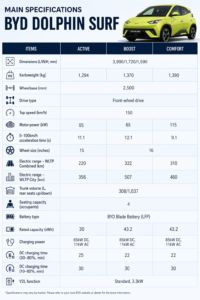
In the DOLPHIN SURF, buyers get two battery options: a 30-kWh version in the entry-level Active model and a larger 43.2 kWh pack in the Boost and Comfort variants. On paper, the combined WLTP range reaches up to around 322 km, but what stands out more is the city range, which can stretch as high as 507 km. For many urban users, that translates into fewer charging stops and, in some cases, weeks of typical commuting on a single charge.
BYD’s strength as a technology-focused company also shows in how tightly everything is integrated. The DOLPHIN SURF uses an 8-in-1 electric powertrain system that combines key components like the motor, charger, control units, and power electronics into a single compact module. It’s the kind of engineering that most drivers won’t notice directly, but it plays a big role in improving efficiency and freeing up space inside the car, which matters a lot in a compact vehicle.
Performance is kept practical but flexible across the lineup. The Active version pairs its smaller battery with a 65-kW motor, delivering a 0–100 km/h time of just over 11 seconds more than enough for city use. The Boost variant focuses on range with the larger battery but keeps the same motor, while the top-end Comfort version steps things up with a 115-kW motor, bringing quicker acceleration and a more responsive drive. It’s not about chasing performance headlines, but about giving buyers options that match their priorities.
Charging is another area where the DOLPHIN SURF feels designed around real-world use. Depending on the version, DC fast charging supports up to 65 kW or 85 kW, allowing the battery to go from 10% to 80% in about 30 minutes. For daily use, standard 11 kW AC charging means a full charge can be completed in a few hours making overnight charging simple and convenient. Together, these features make the car flexible enough for both short daily trips and occasional longer drives (Source: BYD brings fun, future-ready DOLPHIN SURF to European customers).
Step inside, and the approach remains consistent. The cabin feels modern but not overcomplicated, with a rotating touchscreen that adds a bit of personality without becoming distracting. Features like voice control and smartphone integration are there because they’re expected not because they’re trying to impress. It’s a space designed to be used, not just admired.
There’s also a bigger picture to consider. The DOLPHIN SURF arrives at a time when competition in Europe’s affordable EV space is heating up, but still not fully mature. By entering this segment with a relatively aggressive price point and a solid feature set, BYD is effectively raising the bar. It puts pressure on traditional automakers that have been slower to deliver budget-friendly electric options. And with plans to expand its presence locally, the company is signaling that it’s not just testing the waters it’s building a long-term foothold.
What stands out most, though, is the tone of the product. The DOLPHIN SURF doesn’t try to redefine electric vehicles in a dramatic way. Instead, it quietly challenges the idea that EVs have to be expensive or niche. It feels like a car designed for normal routines for commuting, errands, and everyday life rather than something built purely for headlines.
In that sense, the DOLPHIN SURF might end up being more important than it first appears. Not because it’s revolutionary on paper, but because it addresses a real gap in the market. And sometimes, it’s those practical, well-timed solutions that end up shaping where the industry goes next.
Read more: Apple Found Their New CEO Amid Tim Cook Stepping Down

1 Comment
Pingback: Suzuki Fronx Launches In Pakistan: Pak Suzuki Enters The Compact Crossover Segment