
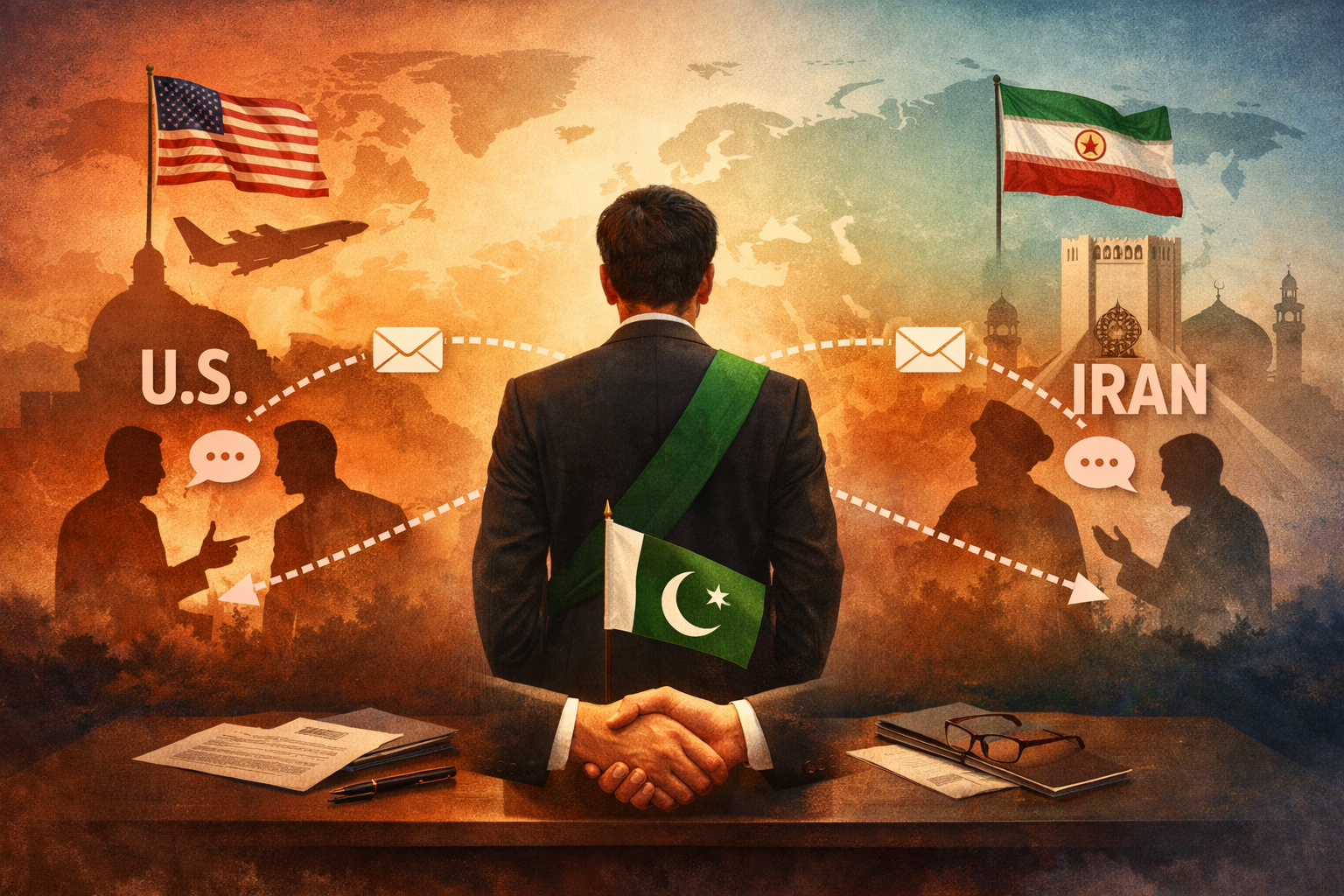

As tension between the United States and Iran continue to shape global energy markets, the question of credible mediators becomes increasingly important. Among regional players, Pakistan occupies a uniquely strategic and diplomatic position one that could allow it to act as a quiet but effective bridge between opposing sides.
While Pakistan may not be a primary power broker like Gulf states or European actors, its geopolitical alignment, historical relationships, and regional credibility give it practical leverage in backchannel diplomacy.
A Balanced Diplomatic Position
Pakistan maintains working relationships with both Washington and Tehran:
- With the United States, Pakistan has a long though complex history of cooperation in security, counterterrorism, and regional stability
- With Iran, Pakistan shares a 900 km border, along with cultural, religious, and economic linkages
This dual engagement allows Pakistan to:
- Communicate with both sides without being seen as overtly partisan
- Act as a neutral messenger, especially during periods of heightened tension
Unlike some Gulf countries that are closely aligned with US strategic interests, Pakistan’s relatively balanced stance can make it a more acceptable intermediary for Iran.
Experience in Quiet Diplomacy
Pakistan has a track record of participating in discreet diplomatic efforts, particularly in conflict-sensitive environments like Afghanistan and the broader Middle East.
Rather than leading high-profile negotiations, Pakistan typically contributes through:
- Backchannel communication
- Confidence-building facilitation
- Intelligence-sharing and de-escalation messaging
This “low-visibility diplomacy” can be especially valuable in US–Iran tensions, where public negotiations are often politically sensitive.
Geographic and Strategic Relevance
Pakistan’s location enhances its importance in any regional de-escalation effort.
- It borders Iran directly, making stability in Iran a national security priority
- It sits near key global energy corridors, including the Strait of Hormuz
- It is central to the China-Pakistan Economic Corridor (CPEC), which depends on regional stability for long-term success
Any escalation between the US and Iran threatens:
- Trade routes
- Energy imports
- Maritime security in the Arabian Sea
This gives Pakistan a strong incentive to promote de-escalation, not just diplomatically but economically.
Acting as a Bridge Between Blocs
Pakistan also has the advantage of being connected to multiple geopolitical blocs:
- Close strategic ties with China
- Working relationships with Gulf countries like Saudi Arabia and United Arab Emirates
- Engagement with Western institutions and policymakers
This positioning allows Pakistan to:
- Relay perspectives across different power centers
- Support broader multilateral mediation efforts
- Align with initiatives led by larger powers without directly leading them
Realistic Role: Facilitator, Not Dealmaker
Pakistan’s most effective role is not as a headline negotiator, but as a facilitator of dialogue. Positioned between key stakeholders such as the United States and Iran, Pakistan can provide discreet communication channels that allow sensitive messages to be exchanged without escalating tensions. By enabling backchannel diplomacy, it can help reduce misunderstandings during critical moments and prevent miscalculations that could lead to further conflict.
At the same time, Pakistan can support broader diplomatic frameworks led by global powers, reinforcing multilateral efforts rather than competing with them. In essence, its strength lies in quietly keeping the door open for dialogue, even when formal negotiations stall.
Strategic Impact on Oil Markets
Pakistan’s mediation efforts, even if indirect, could have ripple effects on global energy markets.
If Pakistan contributes to:
- Reduced tensions
- Improved communication
- Avoidance of military escalation
Then the likelihood of disruptions in key oil transit routes declines helping stabilize prices.
While Pakistan alone cannot determine the outcome of US–Iran relations, it can play a meaningful role in reducing volatility, which is precisely what global oil markets need.
Pakistan’s role in mediating US–Iran tensions lie in its credibility, connectivity, and quiet diplomacy. It is not a power that can impose solutions, but it is one that can enable conversations when they matter most.
In a conflict defined by mistrust and miscalculation, even small diplomatic bridges can prevent larger crises. Pakistan, positioned at the crossroads of regional geopolitics, has the opportunity to be one of those bridges subtle, strategic, and potentially impactful.
